

Sugerencias
Idioma
metricas
Publique en esta revista
Guía para autores
Buscador
Información de la revista
Vol. 60. Núm. 2.
Páginas 71-160 (Abril - Junio 2025)
Visitas
1508
Vol. 60. Núm. 2.
Páginas 71-160 (Abril - Junio 2025)
Scientific letter
Acceso a texto completo
CARABELA-HF: new frontiers in the optimization of heart failure clinical management in Spain
CARABELA-IC: nuevas fronteras en la optimización del tratamiento clínico de la insuficiencia cardiaca en España
Visitas
1508
Álvaro González Francoa,1, José Francisco Sotob,1, Inmaculada Mediavillac, Manuel Leald, Manuel Anguitae,f,
Autor para correspondencia
manuelanguita@secardiologia.es

Corresponding author.
, on behalf of the CARABELA-HF Scientific Committee 2
a Unidad de Gestión Clínica de Medicina Interna, Hospital Universitario Central de Asturias, Oviedo, Asturias, Spain
b Gerencia, Hospital Clínico San Carlos, Madrid, Spain
c Gerencia Asistencial de Atención Primaria, SERMAS, Madrid, Spain
d Departamento Médico, AstraZeneca Farmacéutica Spain, Madrid, Spain
e Unidad de Gestión Clínica de Cardiología, Hospital Universitario Reina Sofía, Instituto Maimónides de Investigación Biomédica de Córdoba (IMIBIC), Universidad de Córdoba, Córdoba, Spain
f Centro de Investigación Biomédica en Red de Enfermedades Cardiovasculares (CIBERCV), Spain
Este artículo ha recibido
Información del artículo
Texto completo
Bibliografía
Descargar PDF
Estadísticas
Figuras (2)
fig0005
fig0010
Texto completo
To the Editor,

The year 2021 witnessed the birth of CARABELA-HF, an initiative set to transform the paradigm of the clinical management of heart failure (HF) in Spain. This initiative, which main objective was to address the improvement areas posed by HF management in Spain and aimed to optimize the HF care pathway with a holistic vision, underpins a mindset that will serve as a catalyst to drive a healthcare system transformation in Spain. It is being implemented as a joint effort between scientific societies and AstraZeneca with the ultimate goal of improving the effectiveness of the whole healthcare management pathway in HF. A Scientific Committee was formed to ensure the active involvement of key stakeholders in the initiative, comprising experts from the major Spanish scientific societies—SEC (Spanish Society of Cardiology), SEMI (Spanish Society of Internal Medicine), and SECA (Spanish Society of Quality of Care)—, and AstraZeneca.

The ultimate goal of CARABELA-HF is to tackle the number 1 killer disease in the world.1 In Spain, where HF occurs at a prevalence of 1.89%2 and accounts for most of cardiovascular-related hospitalizations and deaths,3 an improvement in the overall clinical experience of affected patients would potentially save thousands of lives. Moreover, the threat of HF extends beyond its impact on individuals’ health: this disease generates significant economic costs for the healthcare system that account for up to 2% of all healthcare expenditure in Western countries.4 If no urgent measures are taken, this burden is expected to rise in a landscape of an aging population and the increasing coexistence of risk factors such as hypertension, obesity, and diabetes.2 The deaths and financial costs associated with HF place a strain on society and call for more effective and coordinated clinical management strategies, in line with the overall solutions being developed under the entire CARABELA-HF framework.

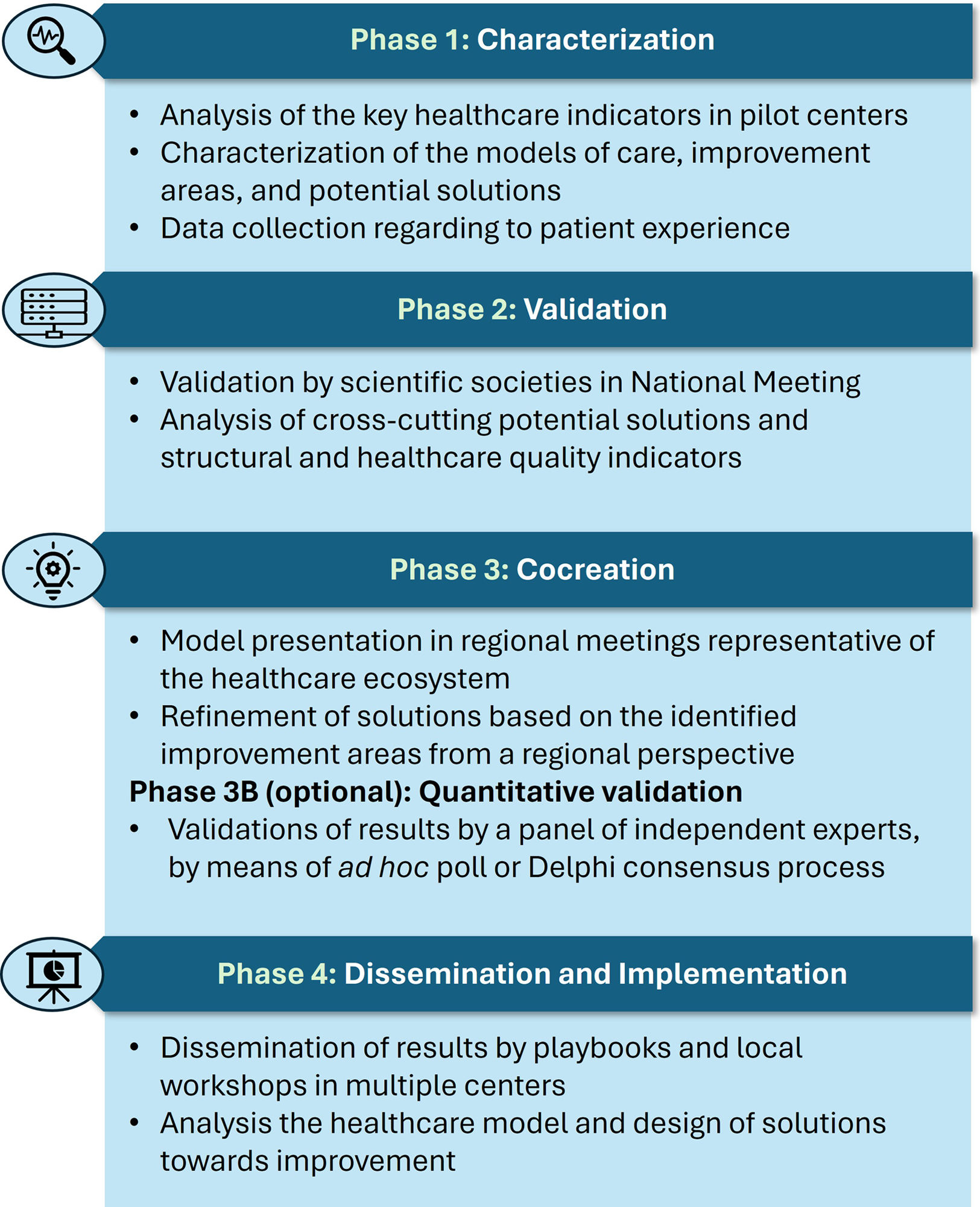
CARABELA-HF initiatives are based on the principles of lean methodology, an innovative process reengineering application designed to boost the effectiveness and sustainability of healthcare management.5,6 Escalada J et al. gathers detailed information regarding the complete methodology followed throughout the CARABELA-HF initiative.5 Evolving healthcare systems must be monitored closely to identify areas for improvement and to address new demands by offering innovative solutions and updates. In this respect, the CARABELA-HF initiatives will guarantee early, homogeneous, and high-quality care for patients with complex, chronic diseases. The CARABELA-HF initiative aims to identify and diagnose healthcare management issues by placing the patient at the center, minimizing inefficiencies, and meeting the expectations of both patients and physicians. This process is implemented by characterizing clinical management models, according to a set of specific healthcare quality indicators in pilot centers (Fig. 1). The proposed models are validated by managing experts appointed by scientific societies in the corresponding National Meeting. Validated models are then presented in regional meetings, where improvement areas and potential solutions are refined from a regional perspective. The improvement areas identified in the context of CARABELA-HF initiative related to four crucial stages of the HF management process, that is, suspicion, diagnosis, treatment, and follow-up, and the potential solutions proposed regarded to coordination and protocols, virtual care model and digital transformation, roles and functions of nursing staff, training of professionals and patient education, accessibility to resources, accredited care models, and data recording and evaluation. These results may undergo further validation by a panel of independent experts (eg, by means of a Delphi process). Finally, the results are disseminated using playbooks and in local workshops conducted in multiple centers to analyze the healthcare model and design actions targeting improvement.5

Fig. 1.

Flowchart of the CARABELA-HF methodology.

Adapted from Escalada J et al.5 with the authorization of the authors of the cited article.

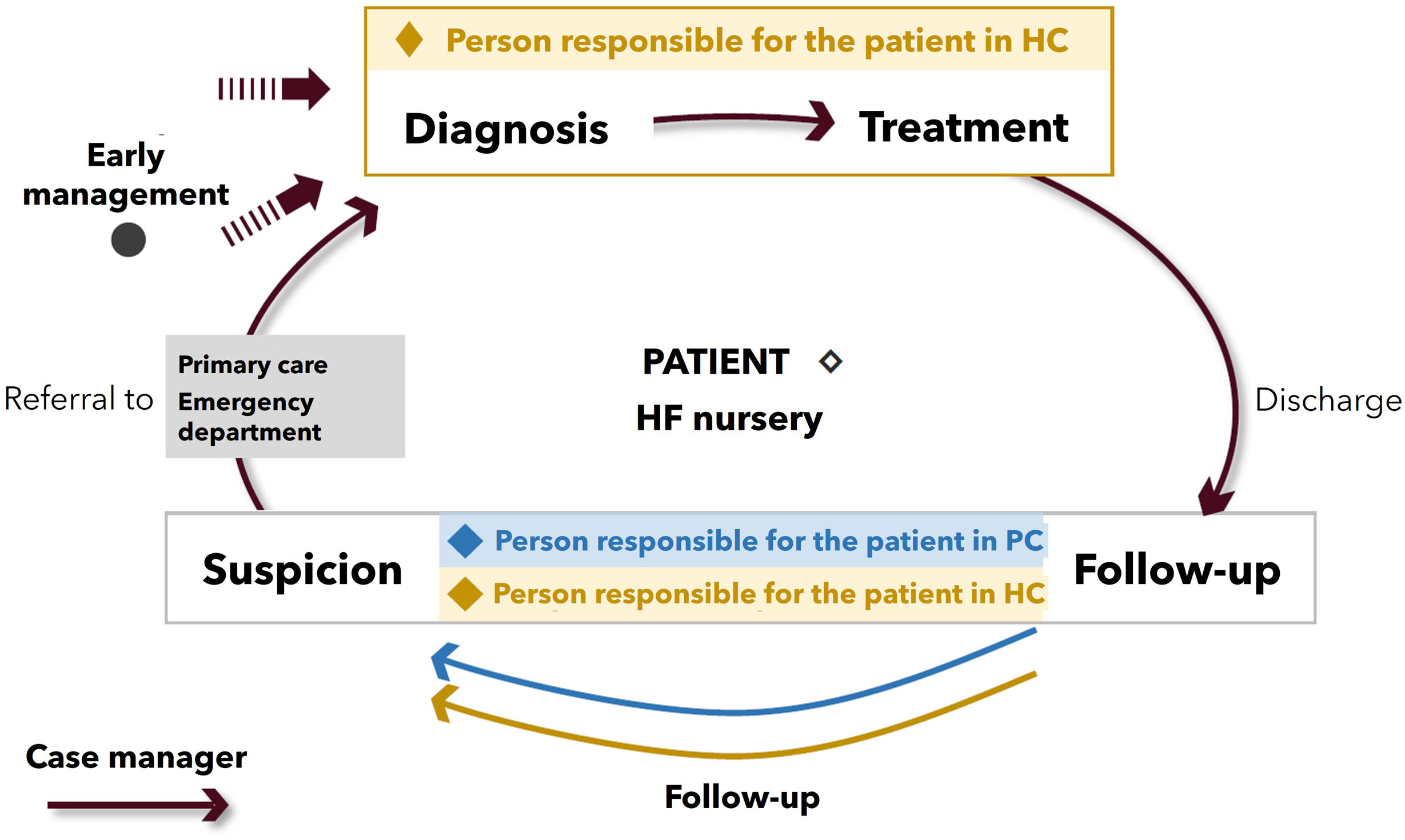
CARABELA-HF aims to achieve excellence in care for HF patients by implementing affordable improvements in the units/services of those centers where HF pathway optimization is needed, according to peer-established parameters. We understand HF clinical management as a circular and multidisciplinary process (Fig. 2) designed to provide integrated care to patients. However, important regional disparities exist between care models, including interdepartmental coordination within the hospital and with primary care. Therefore, as a first step, it was crucial to identify and compare these models among hospitals from the entire Spanish territory. To this end, we developed tools and healthcare quality indicators to measure, homogenize and optimize patient care. The identified structure indicators for the evaluation of care models during the CARABELA-HF initiative were related to the following areas: hospital environment, resources of the HF units, origin and characteristics of patients with HF, and care process. This strategy allowed us to study and characterize the diagnostic approach and the whole HF healthcare management pathway in Spain, promoting the improvement of clinical management by all stakeholders involved.

Fig. 2.

Circular and multidisciplinary HF clinical management process. HC: hospital care; HF: heart failure; PC: primary care.

Initially, it was crucial to identify responsible actors and procedures for patient transitions within and outside the hospital, and to determine the degree of coordination between hospital care professionals (with a focus on cardiology and internal medicine) and primary care professionals. This way, we established variables pertaining to the coordination between the main specialties involved in HF care, the roles and functions of the professionals involved, and the availability of certain resources. These variables were used to define a set of healthcare models with certain characteristics. Healthcare quality indicators were then developed and tested in pilot centers to evaluate the identified models, attributing and prioritizing specific improvement areas (grouped in five challenges) and potential solutions (grouped in seven lines of change) for each one. Finally, action plans were drawn up to address improvement areas in the HF care process. The results of CARABELA-HF were implemented into a playbook to aid the identification of improvement areas and develop action plans in a local-specific manner, to provide the best customized solutions to the characteristics of each health area.

In sum, this Scientific Committee would like to mention and thank the dozens of professionals that participated in CARABELA-HF, and we look forward enthusiastically to presenting our results to the scientific community. We will describe the tools and potential solutions that will boost the development of an optimal model of comprehensive and integrated clinical management designed to optimize the treatment and quality of life of HF patients. Since these patients should be always treated by the most suitable professional according to their needs, effective coordination and communication between cardiology, internal medicine, nursing, primary care, and the other key professionals in the process, is of outmost importance. Work on the identified action areas must be performed in the future to generate a new comprehensive and integrated model that guarantees the best quality of care throughout the entire country, ensuring homogeneity among all centers.

Funding

All support for the present manuscript was provided by AstraZeneca Farmacéutica Spain.

Ethical considerations

Not applicable in this study, as no treatment was performed with patient data.

Statement on the use of artificial intelligence

There has been no use of artificial intelligence.

Authors’ contributions

All authors contributed equally to the CARABELA-HF initiative and to the development of this manuscript.

Conflicts of interest

A. González Franco is member of Sociedad Española de Medicina Interna and has received payment or honoraria for lectures, presentations or educational events from AstraZeneca, Novartis, Bayer, Pfizer, Bristol Myers Squibb, and support for attending meeting and/or travel from AstraZeneca, Boehringer Ingelheim and VIFOR. J. F. Soto declares no conflict of interest. I. Mediavilla is the president of Sociedad Española de Calidad Asistencial and has received payment or honoraria for lectures, presentations, speakers bureaus, manuscript writing or educational events from AstraZeneca, MSD, Novartis, Pfizer, Bristol Myers Squibb, Bayer, and Boehringer Ingelheim; and support for attending meetings and/or travel from Novartis and Pfizer. M. Leal is an employee at the Medical Department of AstraZeneca Farmacéutica Spain. M. Anguita declares no conflict of interest.

Acknowledgements

The authors acknowledge the participation of all the professionals attending the regional meetings of the CARABELA-HF initiative, and of all those involved in the pilot phase, from Hospital Universitario Doctor Negrín (Gran Canaria, Spain), Hospital Universitario Virgen de la Arrixaca (Murcia, Spain), Complejo Hospitalario Universitario A Coruña (A Coruña, Spain), Hospital Universitario de Valencia (Valencia, Spain), Hospital Universitario Virgen Macarena (Seville, Spain), Hospital Universitario Virgen de las Nieves (Granada, Spain), Hospital Clínico San Carlos (Madrid, Spain), Hospital Universitario Santa Creu i Sant Pau (Barcelona, Spain), Hospital Universitario 12 de Octubre (Madrid, Spain), and Hospital Universitario San Pedro de Alcántara (Cáceres, Spain).

Medical writing support under the guidance of the authors was provided by Anchel González, PhD, Blanca Piedrafita, PhD, and Javier Arranz-Nicolás, PhD, from Medical Statistics Consulting (MSC), Valencia, Spain, in accordance with Good Publication Practice guidelines, and funded by AstraZeneca Farmacéutica Spain.

Appendix A

The CARABELA-HF Scientific Committee consists of the following members: Álvaro González Franco (SEMI), Inmaculada Mediavilla (Sociedad Española de Calidad Asistencial), José Francisco Soto (Sociedad Española de Directivos de la Salud), Juana Carretero (SEMI), Julián Pérez-Villacastín (SEC), Manuel Anguita (SEC), Lucía Regadera (AstraZeneca Farmacéutica Spain), Alberto Prado Domínguez (AstraZeneca Farmacéutica Spain), Manuel Leal (AstraZeneca Farmacéutica Spain), and Victoria González Pastor (AstraZeneca Farmacéutica Spain).

References
[1]
World Health Organization. WHO Global Health Estimates. Fact sheet: the top 10 causes of death. 2023. Available at: https://www.who.int/news-room/fact-sheets/detail/the-top-10-causes-of-death#:∼:text=The%20top%20global%20causes%20of,second%20leading%20causes%20of%20death Accessed 2 Sep 2024.
[2]
A. Sicras-Mainar, A. Sicras-Navarro, B. Palacios, L. Varela, J.F. Delgado.
Epidemiology and treatment of heart failure in Spain: the HF-PATHWAYS study.
Rev Esp Cardiol, 75 (2022), pp. 31-38
[3]
Sociedad Española de Cardiología. Estudio RECALCAR. Available at: https://secardiologia.es/images/institucional/proyectos-estrategicos/RECALCAR/Informe_RECALCAR_2022_FINAL_V3.pdf Accessed 16 Jan 2024.
[4]
N. Farré, E. Vela, M. Clèries, et al.
Medical resource use and expenditure in patients with chronic heart failure: a population-based analysis of 88 195 patients.
Eur J Heart Fail, 18 (2016), pp. 1132-1140
[5]
J. Escalada, J. Carretero Gómez, M. Anguita, et al.
Enhancing the management of chronic diseases in clinical practices: the CARABELA methodology.
J Healthc Qual Res, 39 (2024), pp. 336-339
[6]
M. Graban.
Lean Hospitals. Improving Quality, Patient Safety, and Employee Engagement.
third edition, Productivity Press, (2016),

Both authors contributed equally to this manuscript.

The members of the CARABELA-HF Scientific Committee and their affiliations are shown in the Appendix A.

Copyright © 2024. Sociedad Española de Cardiología
Descargar PDF
Idiomas
REC: CardioClinics
Opciones de artículo
Herramientas