

Transthyretin amyloid cardiomyopathy (ATTR-CM) is an increasingly recognized cause of heart failure with preserved ejection fraction. However, conventional measures of systolic function, including left ventricular ejection fraction (LVEF), often fail to detect myocardial dysfunction at early stages. Global longitudinal strain (GLS) has emerged as a sensitive echocardiographic marker capable of identifying subclinical myocardial impairment before changes in LVEF become apparent. This study aimed to evaluate the incremental value of GLS and N-terminal pro-B-type natriuretic peptide (NT-proBNP) for functional stratification in patients with ATTR-CM.
MethodsA cross-sectional study was conducted, including patients with confirmed ATTR-CM who underwent comprehensive clinical, biomarker, and echocardiographic evaluation. The relationship between GLS, NT-proBNP levels, and clinical variables with respect to New York Heart Association (NYHA) functional class was analyzed using correlation analyses and multivariable ordinal regression models.
ResultsOverall, this study included 60 patients, with a mean age of 75.5±10 years and a male predominance (60%). Although LVEF remained preserved in 73.3% of cases, GLS was markedly reduced (−11.6%±4.0%), showing progressive worsening across higher NYHA classes along with attenuation of the apical sparing pattern. Log-transformed NT-proBNP correlated significantly with GLS (ρ=−0.488; P<.001) and with NYHA class (ρ=0.361; P=.008), remaining an independent predictor of functional severity (OR, 1.68; 95%CI, 1.06–2.66).
ConclusionsThese findings support that impairment of longitudinal deformation precedes conventional systolic dysfunction, and that incorporating GLS into multimodal diagnostic strategies could optimize risk stratification in ATTR-CM.
La amiloidosis cardiaca por transtirretina (ATTR) es una causa cada vez más reconocida de insuficiencia cardiaca con fracción de eyección preservada. Sin embargo, las medidas convencionales de función sistólica, incluida la fracción de eyección del ventrículo izquierdo (FEVI), frecuentemente no logran detectar la disfunción miocárdica en etapas tempranas. El strain longitudinal global (SLG) ha surgido como un marcador ecocardiográfico sensible capaz de identificar deterioro miocárdico subclínico antes de que se manifiesten alteraciones en la FEVI. Este estudio se propuso evaluar el valor incremental que aportan el SLG y la fracción aminoterminal del propéptido natriurético cerebral tipo B (NT-proBNP) en la estratificación funcional de pacientes con ATTR.
MétodosSe realizó un estudio transversal que incluyó pacientes con diagnóstico confirmado de ATTR, sometidos a una evaluación clínica, bioquímica y ecocardiográfica integral. Se analizó la relación entre el SLG, los niveles de NT-proBNP y las variables clínicas con respecto a la clase funcional NYHA, mediante análisis de correlación y modelos de regresión ordinal multivariable.
ResultadosEl estudio incluyó 60 pacientes, con edad media de 75,5±10 años y predominio masculino (60%). Aunque la FEVI se mantuvo preservada en el 73,3% de los casos, el SLG se encontró marcadamente reducido (−11,6%±4,0%), con deterioro progresivo en clases NYHA más avanzadas y atenuación del patrón de sparing apical. El logaritmo del NT-proBNP correlacionó significativamente con el SLG (ρ=−0,488; p<0,001) y con la clase NYHA (ρ=0,361; p=0,008), manteniéndose como predictor independiente de gravedad funcional (OR=1,68; IC95%, 1,06-2,66).
ConclusionesEstos hallazgos respaldan que el deterioro de la deformación longitudinal precede a la disfunción sistólica convencional, y que su incorporación a estrategias diagnósticas multimodales podría optimizar la estratificación de riesgo en la ATTR.
Transthyretin amyloid cardiomyopathy (ATTR-CM) has emerged as an increasingly recognized heart failure etiology, particularly among older individuals presenting with left ventricular hypertrophy and preserved ejection fraction. Progressive transthyretin amyloid fibril deposition within the myocardial interstitium causes increased wall thickness, ventricular stiffness, and progressive functional deterioration, leading to a restrictive cardiomyopathic phenotype associated with substantial morbidity and mortality.1,2
Myocardial function evaluation in ATTR-CM remains challenging. Left ventricular ejection fraction (LVEF), the conventional measure of systolic performance, frequently remains preserved until advanced stages of the disease owing to reduced ventricular cavity size and compensatory mechanisms.3 Consequently, LVEF may underestimate the degree of myocardial dysfunction in amyloid cardiomyopathy.
Myocardial deformation imaging using global longitudinal strain (GLS) has gained traction as a sensitive marker of subclinical systolic impairment. The GLS reflects an early dysfunction of subendocardial longitudinal fibers, which are particularly vulnerable to amyloid infiltration.2,4 The characteristic patterns of relative apical sparing has been demonstrated to facilitate the identification of cardiac amyloidosis and help distinguish ATTR-CM from other left ventricular hypertrophy etiologies.4,5 The introduction of disease-modifying therapies has further highlighted the significance of prompt diagnosis and enhanced risk stratification.6,7
Beyond its diagnostic role, GLS has demonstrated prognostic value in patients with ATTR-CM, potentially providing incremental information beyond conventional echocardiographic parameters and circulating biomarkers.8,9 Contemporary diagnostic algorithms increasingly rely on multimodality imaging integrating echocardiography, nuclear scintigraphy, and biomarkers.10,11 Current guidelines and expert consensus statements from the European Society of Cardiology and the American College of Cardiology underscore the significance of these integrated approaches for diagnosing and managing cardiac amyloidosis.11–13
Moreover, emerging genetic data suggest that hereditary forms of ATTR-CM can be particularly relevant in certain populations. The transthyretin Val122Ile variant, historically associated with individuals of African descent, has been identified with a relatively high prevalence among Caribbean populations, including individuals of Dominican origin.14
This study is aimed at evaluating the incremental value of GLS in functional stratification among patients with ATTR-CM; associated with myocardial deformation, biomarkers, and clinical status.
MethodsStudy design and populationThis cross-sectional observational study encompassed consecutive patients evaluated for suspected ATTR-CM by echocardiography and GLS at a tertiary referral center. Among 254 patients who underwent pyrophosphate technetium-99m bone scintigraphy, 60 patients were confirmed with ATTR-CM based on Perugini grade 2 or 3. Diagnosis was established based on contemporary noninvasive criteria positive bone scintigraphy findings. The heart-to-contralateral (H/CL) ratio obtained from bone scintigraphy was recorded as a quantitative measure of myocardial tracer uptake, and SPECT analysis. Kappa and lambda light chain determination were performed in blood to rule out light chain amyloidosis (AL-CM).
This study was conducted following the principles of the Declaration of Helsinki and was approved by the Institutional Ethic Committee of Research Department of Asociación Instituto Dominicano de Cardiología. The patients filled out a consent form to participate in this study.
Clinical and laboratory assessmentData on demographic characteristics, cardiovascular risk factors, comorbidities, and New York Heart Association (NYHA) functional class were recorded at baseline evaluation. N-terminal pro-B-type natriuretic peptide (NT-proBNP) levels were obtained as part of routine clinical assessment, owing to the right skewed distribution. NT-proBNP values were analyzed following logarithmic transformation. Atrial fibrillation was defined as a documented history or electrocardiographic evidence upon evaluation.
Echocardiographic assessmentComprehensive transthoracic echocardiography was performed using Philips EPIQ 7C system (Philips Healthcare, United States). The biplane Simpson method was employed to calculate LVEF. Global longitudinal strain (GLS) was analyzed online by a single observer using the aCMQ (Automated Cardiac Motion Quantification; Philips Healthcare, United States) software, two-dimensional speckle tracking with the standard 17-segment left ventricular model according to the American Society of Echocardiography and the European Association of Cardiovascular Imaging, displayed as a polar map (“bull's eye”). Anatomical Intelligence for automatic recognition of 2C, 3C, and 4C apical views, automatic delineation of the endocardial border and optional manual correction. To facilitate clinical interpretation, absolute GLS (GLS_abs) values were used for statistical analyses, with lower values indicating worse longitudinal systolic function.
Exploratory clinical–functional scoreAn exploratory clinical–functional score was developed integrating the following three domains: biomarker burden, myocardial deformation, and atrial rhythm status. Quartiles of log (NT-proBNP) were used for representing increasing biological risk, whereas inverse quartiles of GLS_abs indicated worsening myocardial mechanics. The presence of atrial fibrillation was assigned 1 additional point. The total score was categorized into four predefined risk levels (low, intermediate, high, and very high) and evaluated according to the NYHA functional class.
Statistical analysisContinuous variables were expressed as means±standard deviations or medians (interquartile ranges), according to distribution, and categorical variables as frequencies and percentages. Distributions of NT-proBNP and GLS_abs across NYHA functional classes were explored using box plots.
Associations between continuous variables were assessed using Spearman rank correlation coefficients (ρ) owing to nonnormal biomarker distributions. To evaluate the robustness of correlation estimates, a sensitivity analysis excluding extreme NT-proBNP levels (≥25000pg/mL).
The association between biomarkers, echocardiographic parameters, and clinical severity was analyzed using ordinal logistic regression models (logit link), with the NYHA class as an ordinal outcome. Two models were evaluated: a baseline model, including log (NT-proBNP), GLS_abs, and H/CL ratio; and an extended model additionally incorporating atrial fibrillation. Results were reported as odds ratios with 95% confidence intervals (95%CI). To assess the incremental contribution of atrial fibrillation, model performance was compared using the Akaike information criterion.
An exploratory clinical–functional score was derived from quartiles of log (NT-proBNP), inverse quartiles of GLS_abs, and the presence of atrial fibrillation, and its distribution was analyzed across NYHA classes.
ResultsBaseline characteristicsAmong 254 consecutive patients undergoing pyrophosphate technetium-99m bone scintigraphy for suspected cardiac amyloidosis, 60 (23.6%) satisfied the inclusion criteria based on Perugini grade 2 or 3 and had complete availability of predefined clinical, biomarker, and echocardiographic variables. The average age of the patients was 75.5±10.0 years (95%CI, 72.9–78.1), and 36 patients (60.0%) were male.
The patients are classified as either NYHA functional class II (51.7%) or III (41.7%), a predominantly symptomatic population. Only 4 patients (6.7%) were in NYHA class I, and no patients were classified as NYHA class IV during evaluation.
The mean LVEF was 60.8%±13.0% (95%CI, 57.5–64.2). Preserved or supranormal systolic function predominated, with 73.3% and 25.0% of the patients demonstrating LVEF of ≥55% and >70%, respectively. Despite LVEF preserved global systolic performance, GLS was consistently impaired across the cohort (mean, −11.6%±4.0%; 95%CI, −12.7 to −10.6), indicating significant longitudinal systolic dysfunction despite largely preserved ejection fraction.
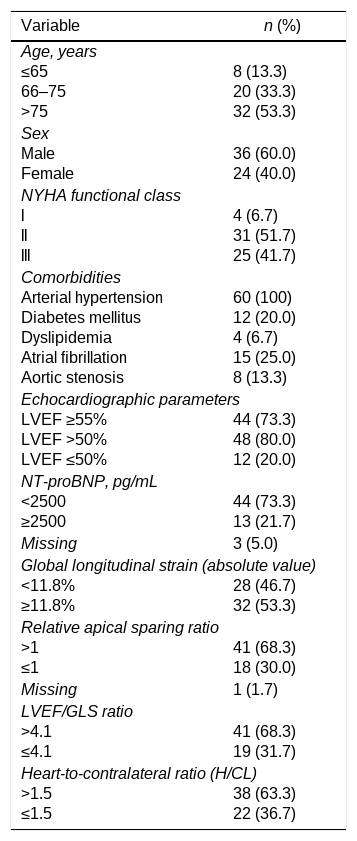
NT-proBNP values showed a right-skewed distribution, with a median level of 1238 (interquartile range, [500–2319]) pg/mL. All patients (100%) exhibited arterial hypertension. Atrial fibrillation, diabetes mellitus, and dyslipidemia were documented in 25.0%, 20.0%, and 6.7% of the patients, respectively. Aortic stenosis was noted in 8 patients (13.3%) (Table 1).
Baseline characteristics of the study population.
| Variable | n (%) |
|---|---|
| Age, years | |
| ≤65 | 8 (13.3) |
| 66–75 | 20 (33.3) |
| >75 | 32 (53.3) |
| Sex | |
| Male | 36 (60.0) |
| Female | 24 (40.0) |
| NYHA functional class | |
| I | 4 (6.7) |
| II | 31 (51.7) |
| III | 25 (41.7) |
| Comorbidities | |
| Arterial hypertension | 60 (100) |
| Diabetes mellitus | 12 (20.0) |
| Dyslipidemia | 4 (6.7) |
| Atrial fibrillation | 15 (25.0) |
| Aortic stenosis | 8 (13.3) |
| Echocardiographic parameters | |
| LVEF ≥55% | 44 (73.3) |
| LVEF >50% | 48 (80.0) |
| LVEF ≤50% | 12 (20.0) |
| NT-proBNP, pg/mL | |
| <2500 | 44 (73.3) |
| ≥2500 | 13 (21.7) |
| Missing | 3 (5.0) |
| Global longitudinal strain (absolute value) | |
| <11.8% | 28 (46.7) |
| ≥11.8% | 32 (53.3) |
| Relative apical sparing ratio | |
| >1 | 41 (68.3) |
| ≤1 | 18 (30.0) |
| Missing | 1 (1.7) |
| LVEF/GLS ratio | |
| >4.1 | 41 (68.3) |
| ≤4.1 | 19 (31.7) |
| Heart-to-contralateral ratio (H/CL) | |
| >1.5 | 38 (63.3) |
| ≤1.5 | 22 (36.7) |
GLS, global longitudinal strain; H/CL, heart-to-contralateral ratio; LVEF, left ventricular ejection fraction; NT-proBNP, N-terminal pro-B-type natriuretic peptide; NYHA, New York Heart Association.
Data are expressed as no. (%).
The GLS impairment was evident across the study population, despite preserved or supranormal LVEF values, supporting the presence of functional–mechanical dissociation typical of ATTR-CM.
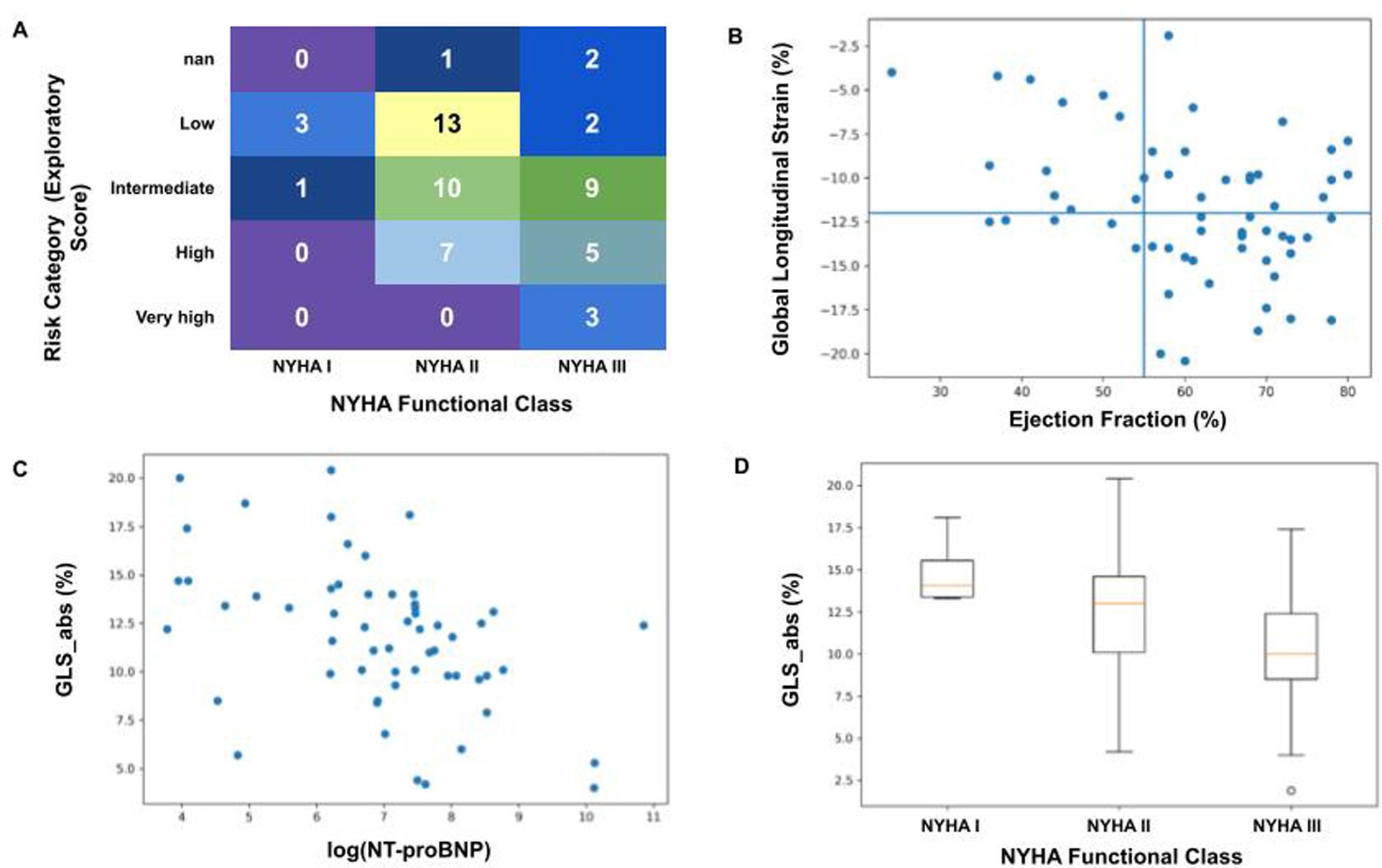
An exploratory functional risk score incorporating log (NT-proBNP), absolute GLS, and the presence of atrial fibrillation revealed progressive stratification according to the NYHA functional class (Fig. 1A). Higher score categories were increasingly represented among patients with severe functional limitations, suggesting internal consistency between biomarker burden, myocardial deformation, and clinical status.
Risk stratification and associations between myocardial deformation, biomarkers, and functional status. A) Distribution of the exploratory score according to the NYHA functional class. The score encompassing quartiles of log(NT-proBNP), inverse quartiles of (GLS_abs), and atrial fibrillation. B) Negative association between (LVEF) and (GLS), illustrating preserved LVEF despite reduced GLS. C) Inverse association between log (NT-proBNP) and GLS_abs. D) GLS_abs distribution across NYHA classes (box plots). GLS, global longitudinal strain; GLS_abs, absolute global longitudinal strain; LVEF, left ventricular ejection fraction; NYHA, New York Heart Association; NT-proBNP, N-terminal pro-B-type natriuretic peptide.
The association between LVEF and GLS is shown in Fig. 1B. Scatterplot analysis revealed significant discordance between conventional systolic function assessment and myocardial deformation parameters.
The GLS was inversely associated with log (NT-proBNP) (Fig. 1C), demonstrating an association between impairment in longitudinal myocardial mechanics that accompanied increasing neurohormonal activation. This association was consistent across the spectrum of biomarker values, without clear threshold effects.
In the baseline ordinal model, log (NT-proBNP) was independently associated with greater functional severity (OR, 1.68; 95%CI, 1.06–2.66; P=.027), while GLS_abs (OR, 0.92; 95%CI, 0.77–1.11; P=.385) and H/CL (OR, 0.95; 95%CI, 0.19–4.84; P=.953) did not reach statistical significance. In the extended model with atrial fibrillation, log (NT-proBNP) maintained its association with the NYHA functional class (OR, 1.78; 95%CI, 1.05–3.03; P=.033) (Fig. 2).
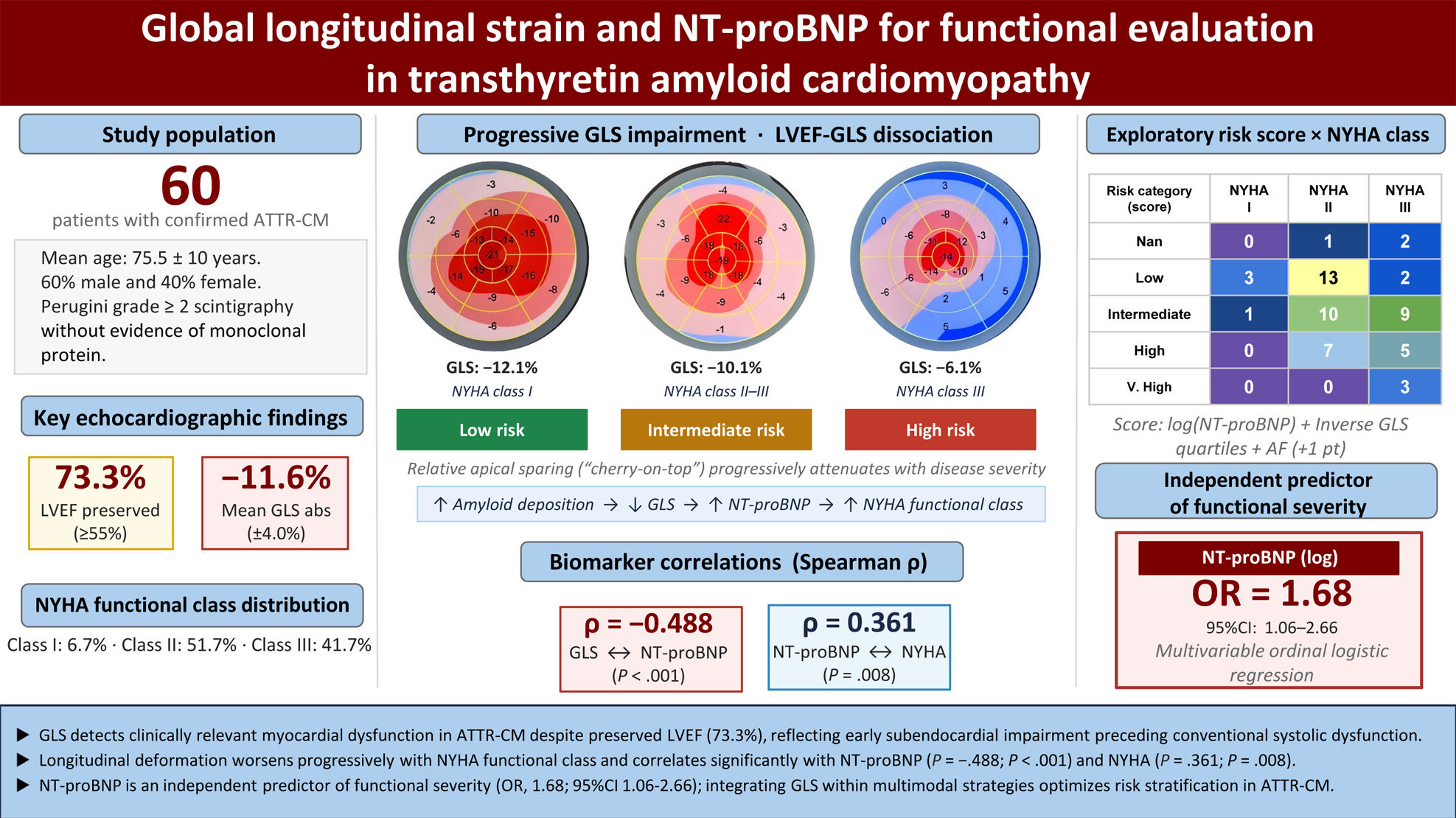
Central illustration. Global longitudinal strain and NT-proBNP for functional evaluation in transthyretin amyloid cardiomyopathy. Progressive GLS impairment across New York Heart Association functional classes is illustrated by bull's-eye polar maps, demonstrating attenuation of the relative apical sparing pattern with advancing disease. GLS correlated inversely with NT-proBNP (ρ=−0.488; P<.001) and NT-proBNP correlated with functional class (ρ=0.361; P=.008). NT-proBNP was an independent predictor of functional severity (OR, 1.68; 95%CI, 1.06–2.66). 95%CI, 95% confidence interval; AF, atrial fibrillation; ATTR-CM, transthyretin amyloid cardiomyopathy; GLS, global longitudinal strain; LVEF, left ventricular ejection fraction; NT-proBNP, N-terminal pro-B-type natriuretic peptide; NYHA, New York Heart Association; OR, odds ratio.
In this cohort of patients with ATTR-CM, GLS clinically identified relevant myocardial dysfunction, despite predominantly preserved LVEF. This critical finding confirms the characteristic structural–functional dissociation wherein conventional systolic parameters and the degree of myocardial involvement.2,4
NYHA functional classes demonstrated a decline in GLS, suggesting that longitudinal myocardial deformation more directly, therefore, reflecting the disease severity.
Previous studies have reported a correlation between impaired GLS and biomarker burden, clinical progression, and adverse outcomes in patients with ATTR-CM.8,9 These findings support the concept that myocardial deformation imaging offers functional information not captured by conventional systolic performance measures.
Incremental value of global longitudinal strainAlthough multivariable analysis revealed NT-proBNP is the strongest independent predictor of functional severity. The GLS demonstrated consistent associations with both biomarker burden and clinical status. These findings suggest that GLS offers complementary physiological information within integrated risk assessment strategies.
Several studies have indicated that myocardial deformation parameters improve the phenotypic characterization of ATTR-CM when interpreted within multimodal frameworks integrating echocardiography, nuclear imaging, and circulating biomarkers.10,15 Furthermore, contemporary cohort studies have suggested that systolic dysfunction detected using strain imaging can have prognostic implications even in patients with preserved conventional systolic function.9 Additionally, meta-analyses have confirmed that GLS reduction represents reproducible echocardiographic marker of cardiac amyloidosis.5,16
Genetic perspectives in Dominican and Latin American populationsRecent evidence has emphasized the potential significance of genetic susceptibility in ATTR-CM among certain populations. The transthyretin Val122Ile variant is a well-recognized etiology of hereditary ATTR-CM with predominant cardiac involvement and has been historically associated with individuals of African descent.14,17
More recent genomic studies have revealed that this variant is also detected in Caribbean and Hispanic populations. An analysis from the Hispanic Community Health Study/Study of Latinos reported an approximately 2.6% prevalence of the Val122Ile mutation among individuals of Dominican origin, which was significantly higher than that in other Hispanic subgroups.18 These findings potentially reflect the complex admixture of African, European, and Caribbean descents within the Dominican population and suggest that hereditary ATTR can be underrecognized in certain Latin American populations. From a clinical viewpoint, these findings highlight the significance of considering genetic background in patients presenting with unexplained hypertrophy or heart failure with LVEF.
Clinical implicationsFrom a clinical perspective, our findings support routinely incorporating GLS into echocardiographic evaluation of patients with suspected or confirmed ATTR-CM. The prompt myocardial dysfunction detection is particularly relevant in the current therapeutic era, wherein transthyretin-stabilizing therapies have demonstrated survival benefits and may influence disease progression.19,20
Furthermore, international guidelines and consensus statements underscore the significance of multimodal diagnostic approaches integrating imaging findings, biomarkers, and clinical characteristics to optimize cardiac amyloidosis diagnosis and management.12,16,21-24
Study novelty and contributionMoreover, this study contributes to the mounting evidence supporting the role of myocardial deformation imaging in ATTR-CM by demonstrating the association between GLS impairment, biomarker burden, and functional status in a real-world clinical cohort.
LimitationsThe proposed clinical–functional score should be considered strictly exploratory. Its construction was based on quartiles of available variables and the dichotomous inclusion of atrial fibrillation, without formal derivation of weights using predictive models or internal/external validation. Therefore, its categories should not be interpreted as definitive clinical cut-off points or as a validated score. Its utility must be evaluated in future derivation and validation cohorts.
This study did not perform a formal quantitative comparison with established ATTR-CM prognostic staging systems (e.g., Gillmore/Mayo staging), as the absence of longitudinal outcome data precluded a valid comparison of predictive performance; this represents an important direction for future validation cohorts.
The study did not include longitudinal follow-up or major clinical outcomes such as mortality, hospitalizations, or treatment response. Consequently, the results are limited to cross-sectional associations with NYHA functional class and do not allow establishing the prognostic value of the analyzed markers.
Future prospective studies should evaluate whether GLS, NT-proBNP, or the exploratory score associate with relevant clinical outcomes.
ConclusionsThe study analyzes the value of GLS and NT-proBNP in 60 patients with ATTR-CM. Although most patients have LVEF, the GLS identifies clinically early myocardial dysfunction. In addition, it was observed worse NYHA functional class, correlated with higher NT-proBNP levels. NT-proBNP emerged as the main predictor of functional severity, while GLS provided relevant complementary information.
We conclude that GLS may improve early diagnosis and risk stratification for this disease. The proposed clinical–functional score should be considered strictly exploratory.
Its usefulness should be evaluated in future validation cohorts. with GLS, NYHA functional class and NT-proBNP levels, but it did not evaluate clinical follow-up and hard outcomes.
FundingThis research did not receive any specific grant from funding agencies in the public, commercial, or not-for-profit sectors. The authors received no financial support for the research, authorship, or publication of this article.
Ethical considerationsThis study was conducted following the principles of the Declaration of Helsinki and was approved by the Institutional Ethics Committee of the Research Department of Asociación Instituto Dominicano de Cardiología. The patients filled out a consent form to participate in this study. In accordance with the SAGER guidelines, sex was considered as a biological variable in the design and interpretation of this study.
Statement on the use of artificial intelligenceThe authors declare that no artificial intelligence (AI) or AI-assisted technologies were used in the writing, analysis, generation of content, or preparation of figures, tables, or data for this manuscript. Language editing support was provided by ENAGO through human, non-AI professional editing services.
Authors’ contributionsK. Almonte Montes de Oca: conceptualization, study design, methodology, formal analysis, investigation, writing – original draft, writing – review & editing, supervision, and project administration. R.N. Cueto: investigation, including patient recruitment and clinical data acquisition; writing – review & editing. N. Díaz Estrella: investigation, including patient recruitment and echocardiographic data acquisition; writing – review & editing. Y. Delgado: investigation, including patient recruitment and clinical data acquisition; writing – review & editing. L. del A. Javier: investigation, including patient recruitment and clinical data acquisition; writing – review & editing.
S. Divanne-González: investigation, including patient interviews and clinical data collection; data curation; writing – original draft; writing – review & editing. O. Ortega: investigation, including patient recruitment and echocardiographic data acquisition; writing – review & editing. J. Pichardo: resources and institutional supervision as Medical Director; writing – review & editing. M. Arias: resources and institutional supervision as Medical Director; writing – review & editing. E. Díaz Álvarez: investigation, including patient recruitment and clinical data acquisition; writing – review & editing. All authors read and approved the final version of the manuscript.
Conflicts of interestThe authors declare no conflict of interest.
- –
Transthyretin amyloid cardiomyopathy (ATTR-CM) is an increasingly recognized cause of heart failure with preserved ejection fraction.
- –
Left ventricular ejection fraction (LVEF), the conventional measure of systolic function, often remains preserved until advanced disease stages, potentially underestimating the degree of myocardial dysfunction.
- –
Global longitudinal strain (GLS) has emerged as a sensitive echocardiographic marker capable of detecting subclinical myocardial impairment before changes in LVEF become apparent.
- –
The relative apical sparing pattern facilitates the differential diagnosis of this entity.
- –
In 60 patients with ATTR-CM, GLS was markedly reduced despite preserved LVEF in most cases, reflecting functional–mechanical dissociation.
- –
GLS showed progressive worsening and attenuation of apical sparing across higher NYHA classes.
- –
NT-proBNP correlated inversely with GLS and was confirmed as an independent predictor of functional severity (OR, 1.68; 95%CI, 1.06–2.66), while GLS provided complementary information.
- –
The study also highlights the genetic relevance of the Val122Ile variant in Dominican and Caribbean populations.
The authors thank the Asociación Instituto Dominicano de Cardiología and CEDISA/Santo Domingo Cardiovascular Foundation for their collaboration in facilitating patient access and the performance of the studies required for accurate diagnosis. We acknowledge the contribution of Dr. Manuel Colome for his support in statistical analysis. We would like to thank AstraZeneca and Dominican Society of Cardiology for its support in this project and ENAGO for its contribution to editing and drafting of this article. We also thank Dr. Manuel de los Santos, Dr. Eunices Tavarez and Dr. Julia Silverio for patient referral. Finally, we are grateful to the patients for their participation and cooperation.